Posts mit dem Label Soviet werden angezeigt. Alle Posts anzeigen

Sonntag, 8. Juni 2014

Flames of War - Scenario - Skirmish / Soloplay - Dunajek Bridge

Eastern Front - 1944 January- Army Group North - Poland

Historical Background: 

On January 12, the troops of the 1st Ukrainian Front (Konev) launched a mayor attack from the Baranów bridgehead towards Silesia. With tremendous troop and material usage Soviet attacks smashed the german lines after two one hour each lasting artillery barrage. On the first day there were deep penetrations into the german front line done, and on January 15 there was no coherent German front in this area anymore.

German orders:
For hours there was this tremendous artillery barrage on the frontline troops. You are a bit backwards with the duty to fortify the wooden bridge for retreating own troops which are located at the city of Zabno some couple of kilometers away. The small town you made a home during the last couple of weeks is called Wai Ruda. The next german "fortress town" there your staff is awaiting orders is Szczurowa. The bridge is ready to be blown up but instead of doing so after this soviet attack you wait for german refugee units. Your orders are to hold open the bridge as long as possible for retreating german units. If soviet forces try to cross the river blow the bridge up.

Soviet orders:
The attack is going well and the germans are withdrawing. We smashed through their lines and now our spearhead to the west is making fast progress. We just passed through Zabno without encountering any resistance at all and now are approaching the small wood between Zabno and Wai Ruda. Our orders are simple. Try to sniff our more german intruders and punch them into the snow. Any resistance is to be put down. Capture the bridge if it is not blown up already.

Tablesize:
This is a limited table sized 60cm by 120cm. The german deployment is on the southern part of the river. Every unit is entrenched. Pak and SMG are laid in ambush as well as the infantry.

Soviet forces start in the northern part. Mainly on the road with the two T-34 leading.
The river does not support a ford. The only crossing is the bridge. Whoever secures the bridge wins the game

Terrain (table size 60cm wide, 120cm long):
The river Dunajek divides the table into two halves. From the upper left corner a road commences in a corner towards the bridge which sits in the middle of the table. The area in the soviet deployment zone supports some more woods. A small hill covers the advance of the road starting from the corner.
The lower side has some small woods on the left corner. A hill is located on the right corner. Right before the hill two russian houses were build. In one the german SMG Team starts. A bit left you have the entrenched Pak38. The road commences from the bridge in an arc to the left corner. Foxholes for the infantry are dug before the wood.


Specials:

Due to heavy snowfall during the last days the communicationline to blow up the bridge doesnt work properly. To fix the problem the german player sends out one stand each round to fix the problem. This takes one full turn. Means the german player needs two turns in total to find and fix the line properly. The line can only be blown up by the Pak 38 crew. As the missing link is recognised in turn one this specialty starts in turn 2.


The german Pak Stand can only be penetrated by a shell from the ISU-152. However the T-34 shells can force the Pak team to hold their heads down.

Forces:

German Forces:
1 Pak 38 
1 SMG Team
1 Platoon Panzergrenadiers (free choice if you agree to use anti tank weapons or not)


Soviet Force:
1 T-34-85 OBR 1944
1 T-34 obr 1942-OT-34 (57mm gun) 
1 ISU-152
1 Platoon Strelkovy (Winter) without Komissar

Making the winner:

Victory Points:
Soviet Points:
+1 Capture the bridge
+1 for the soviets if they destroy the Pak Stand before the bridge can be blown up
+1 for the soviets for each stand destroyed who tries to fix and repair the line


German Points:
+1 hold the bridge or blow it up 
+1 for each stand of killed infantry
+2 for each tank destroyed

Germans can´t win on points if bridge is secured by soviet forces. Soviets can win on points even if bridge is destroyed.



Mittwoch, 18. Dezember 2013

Flames of War - Scenario - "Unternehmen Trappenjagd" Part 2 - Historical Forces

Forces available:

German OOB:
 
Heeresgruppe Süd (South):

Armeeoberkommando (AOK) 11:

German OOB: Kriegsgliederung vom 11.5.1942:

*Units listed from north to south:

VII (7) Romanian Corps:

19. (Romanian) Infantry Division

8. (Romanian) Cavalry Division
Misc.Units: 10. (Romanian) Infantry Division added during the battle.


XXXXII (42) Armeekorps (AK):

46. Infanterie-Division

50. Infanterie-Division

Misc.Units: nil.

XXX (30) Armeekorps (AK):

132. Infanterie-Division

28. Leichte Infanterie-Division

170. Infanterie-Division

Misc.Units: Group "Ritter" - Küstenschutz (coastal protection).


AOK Reserves:


22. Panzer-Division (stationed behind XXX AK.)

"Groddeck" (Oberst Karl Albrecht von Groddeck) Infanterie-Brigade (mot.):

Order of Battle:

1.  Group "Korne" (Rumanian Colonel Radu Korne)

---- 3. (Romanian) Cavalry Regt. (mot.)

---- 22. Aufklärungs-Abteilung (mot.) (Motorized Recon. Bn.)

---- 560. Panzerjäger-Abteilung (Anti-Tank Bn.)

---- 6th Coy./ II Bn.. / 800. Brandenburg Regiment (mot.)

---- I Bn./ 391. Infanterie-Regiment

---- 154. Artillerie-Abteilung (mot.)

---- 6th Btty./ 818. schwere (heavy) Artillerie-Abteilung (mot.)

---- 1 Btty. from Sturmgeschütz-Abteilung (Assault-Gun Bn.) 197.

---- 1 Btty. from Nebelwefer-Regiment (Rocket launcher Regt.) 70 (mot.)

---- 1 lei.Btty. (light battery) from 64. Heeres-Fla (Flak)-Bataillon (mot.)

---- 1 schwere.Btty. (heavy battery) from 64. Heeres-Fla (Flak)-Bataillon (mot.)

---- 1 Coy. from  Pionier (Engineer)-Bataillon 173.

2. Group "Müller" (attached):

---- 401. Infanterie-Regiment (mot.)
---- I Bn./ 105. Infanterie-Regiment
---- 223. Panzer-Bataillon
---- Stab Artillerie-Regiment 54. (mot.)
---- II Btty./ Artillerie-Bataillon 54. (mot.)
---- II Btty./ Artillerie-Bataillon 57. (mot.)
---- III.Coy./ Pionier (Engineer)-Bataillon 132.

---- 14.Trp./ 105. Panzerjäger-Abteilung (Anti-Tank Bn.)

---- 1 Btty. from Sturmgeschütz-Abteilung (Assault-Gun Bn.) 190.


Source: National Archives microfilm: series T312/ roll #1692/ frame 77

The German OOB info was researched by John Mulholland.


The Soviet Union:

 Soviet OOB:
  44th Army: 

    Rifle Divisions: 157, 404
    Mtn. Rifle Division:  63, 236
    Mtn. Rifle Regiment:  251, 105
    Artillery:  547 Gun AR, 31, 339, 513 AAABn
    Tank:  79, 126 Tank Bn., 24 Tank Regt.
    Air: 25, 27, 135 FAD, 40 CAS, 152 RAS
    Engineers:  61 Ebn, 19 Sbn

  47th Army:
    Mtn. Rifle Division:  77 (-105 MtnRR), 138
    Artillery:  136 HowARhp, 335 AAAbn
    Tank:  56 Atr
    Engineer:  256 Ebn

  51st Army:
    Rifle Divisions:  224, 390, 396
    Mtn. Rifle Division:  302
    Rifle Brigades:  12, 83 NRB
    Artillery:  25, 53, 456 AR, 457 Gun AR, 1/7 GMR, 180, 220 AAbn
    Tank:  124 Tank Bn.
    Air:  71 MAD, 72 FAD, 2 AAR, 23 CAS, 151, 507 RAS
    Engineers:  75, 132 EBn, 6, 54 PBBn, 205, 275, 82 SBn, 138 EBn


Sonntag, 15. Dezember 2013

Flames of War - Scenario - "Unternehmen Trappenjagd" Part 1 - Historical Background

Battle of the Kerch Peninsula (German: Unternehmen Trappenjagd) (Russian Керченско-Феодосийская десантная операция (Kerchensko-Feodosiyskaya desantnaya operatsiya, 'Kerch-Feodosiya landing operation')) was a World War II offensive by German and Romanian armies against the Soviet Crimean Front forces defending the Kerch Peninsula, in the eastern part of the Crimea. It was launched on 8 May 1942 and concluded around 18 May 1942 with the near complete destruction of the Soviet defending forces. The Red Army lost over 170,000 men killed or taken prisoner, and three armies (44th, 47th, and 51st) with twenty-one divisions.The operation was one of the battles immediately preceding the German summer offensive (Fall Blau), and its successful conclusion made it possible for the Axis to launch a successful assault on Sevastopol in the following months.
Some groups of Soviet survivors refused to surrender and fought on for many months, hiding in the catacombs of the quarries. Many of these soldiers were occupying the caves along with many civilians, who had fled the city of Kerch.

(Source: Wikipedia)

Historical Background:

The Battle:

Trappenjagd began at 04:15 on 8 May. Fliegerkorps VIII operating under Luftflotte 4, began operations against lines of communication and against Soviet airfields. Within hours, Ju 87s of StG 77 had knocked out most of the Soviet 44th Army's communications. The airfields were also virtually destroyed and 57 of the 401 Soviet aircraft in the area were shot down in just 2,100 sorties. Having knocked out the army's Headquarters, the Soviets could not organise a counter offensive and the 44th Army collapsed into a retreat when von Manstein launched the ground attack.
Von Manstein had five infantry divisions, one Panzer Division (22nd Panzer Division), and two and a half Romanian Divisions against 19 Soviet divisions and four armoured brigades at Kerch. He committed his units in the south against the 44th Army. The 902nd Assault Boat Command of the 436th Regiment, 132nd German Infantry Division, landed behind the Soviet lines and helped unbuckle the Soviet second lines. The artillery bombardment lasted only 10 minutes, and within three and a half hours of the assault being launched, the 44th Army collapsed. On the first day, XXX Corps, attacking with the 28th, 50th and 132nd Divisions had broken through in the south. At a cost of 104 killed and 284 wounded, they captured 4,514 Soviet soldiers. Kozlov did not appreciate the significance of the German breakthrough and failed to release reserves for a counter-attack. On 9 May, von Manstein committed the 22nd Panzer Division, which swung north and trapped the 51st Army against the Sea of Azov. Soviet morale and organisation collapsed, and a stampede to the rear areas began. Once this happened, the eight divisions of the 51st Army surrendered releasing XXX Corps to pursue the fragments of retreating Soviet forces to Marfovka, barely eight miles from Kerch.


Flames of War - 15mm - Plastic Soldier WW2 Russian 45mm anti tank gun

Well got this one for approx one third of the new prize at ebay. Still sealed.. not opened.. What a bargain... so enjoy :

Manufacturer: Plastic Soldier Company
Scale: 15mm
Metal/Plastic: Plastic
Number of Guns: 4
Number of Miniatures: 23

(The HQ Stand btw.. is Battlefront leftovers)


Sonntag, 13. Oktober 2013

Flames of War - Scenario - Solo Gaming - Release of the Partizans/PoW

Solo Gaming - Scenario - Release of the Partizans/PoW:

Table size: 120 by 120cm
Terrain: centerpiece is a barn. Place approx one road leading to the barn, couple of woods or cropfields around it or small hills (whatever suits best to your campaignsetting)

A leader of the local partizan group has tried to make contact with the Allied. Allied intelligence has despatched a small force to meet with the resistance and to bring him to Headquarters. Unfortunately a roving patrol of Germans stumble on the partizans hiding place.
The leader of the German patrol suspects the mysterious group of being a partizan and send for assistance while he questions him.
The allies realise what has happened and must rescue the Partizan leader before he can be taken away by the Germans.

The game begins with a unit of three squads infantry led by a command occupying the farm. The officers command and one stand of germans are positioned inside the barn guarding the partizan leader and his companion (one stand of allied force ) . The others are stationed around the farm.

The eight allied stands enter the table with their officer on the road at the eastern edge of the table.

From Turn three onwards roll to see if any reinforcements arrive. On a d6 roll of 1 or 6 the reinforcements would turn up 2-5 nothing arrives. At a dice score of 1 German troops arrive, on a score of  6 Allied troops come. After the reinforcements start to arrive this dice roll turns to 1-3 German reinforcements would come, 4-6 Allied reinforcements come, each turn. Each side gains d6 stands reinforcements entering at the initial starting points.

As soon as hand to hand combat can be heard in the farm yard, the two Partizans have to make a test (in this case they are handled as veterans). If they pass they attack the soldier guarding them and attempt to escape.

Victory Conditions:

The Allied must release the two Partizans and escape off the board with them.

The Germans must prevent the escape of the Partizans.

If the Partizans die, the game is a draw.


Initial forces:

Axis:
1 Platoon of German Infantry

Allies:
1 Platoon of Allied Infantry


PS: This also is compatible with Bolt Action..if you substitute Stand with one Bolt Action Miniature or Platoon with score

Samstag, 28. September 2013

Flames of War - New additions -

Battlefront - 15mm - German -Tank Hunter Teams (GE773) with Von Der Heydte, Fallschirmjägerkompanie


While traveling to Cork today I turned up at the "Other realms" Store and got a shock. Someone simply tried to paint the starter box and all I could figure out was that this was a job NOT done. Everything looked simply out of place and either dark green or dark yellow. Plastic Soldiers by Revell look like that if you unbox them... so I went home to do it better....

This time painted: Tank Hunter Teams (GE773) with Von der Heydte, Fallschirmjäger Germans


Manufacturer: Battlefront
Plastic/Metal: Metal
Scale: 15mm
Number of Miniatures: 19


Battlefront - 15mm - Soviet DShK HMG on Truck (SU162)

Still with todays shock I also worked on my soviet DShK HMG on Truck (SU162) and finished it...

Manufacturer: Battlefront
Plastic/Metal : Metal - Truck is made of resin
Scale: 15mm
Number of Miniatures: 4 and one truck (4th mini is the truck driver)


Freitag, 27. September 2013

New pieces finished painting. Russian SU-85 and a terrain bridge

This one is a leftover from my last month and I am fine with finally finishing it as the first two models for october. Jesus... time passes by really fast.

I am really pleased to say that this was a quite uncomplicated model. A bit glueing and then straight to the priming.

So enjoy:

Manufacturer: Battlefront
Plastic/Metal: Metal (with plastic tracks)
Miniatures: 2  (each blister contains one miniature and offers different options)
Scale: 15mm


As with this swollen backlog from September I need to paint faster or more miniatures at the same time. Pressure is on me here.

This bridge is from resin and was an ebay auction that I won. It fits perfect to 6mm up to 15mm. Love the outcome:

Terrain: Bridge
Scale : 6mm to 15mm
Manufacturer: unknown


Montag, 19. August 2013

Weekend Painting - Flames of War

As my stepson has had some visitors over the weekend I needed the calmness of painting. Take some good music and go ahead with something in your mind.

The finished pieces are quite remarkable....

5 Panzer III / Flames of War / Plastic Soldier Company / 15mm


2 SU-122 / Flames of War / Battlefront Miniatures / 15mm


No decals by now as I still would need to order them. Simply I did run out on decals last month

Samstag, 20. April 2013

Flames of War - Painting Guide - Faces

Hi all,

yes you can do it .. and it still is a fascinating thing. Painting the face to a 15mm figure..... horrible experience ? No idea on how to do it..??? Lets go:

Use a wet palette made with a Folgers Coffee can lid, wax paper and ass-wipe. Add water and your paints stay wet for days... Too bad it doesn't work on the wife...upsssss

To paint faces, I use Vallejo colors from top right to left:

817 Scarlet
876 Brown Sand
803 Brown Rose
342 Highlights Flesh (white and flat flesh same-same)
845 Sunny Skin Tone
955 Flat Flesh
822 German Camo Black Brown
872 Chocolate Brown

I also use 815 Basic Skin Tone as the basecoat. Lets see, thats 9 plus white and black. Holy crap! No wonder its taking me so long to finish anything! I begin by taking a white-primed figure and painting an undercoat of 815 on all the face and hands. Try to keep the paint thin. I add about 1/2 drop of water to a full drop of well-shaken paint. I let this dry usually overnight but if you are in a hurry, into the oven for about 15 minutes at 65-70 degrees celsius.Then its up for slight drybrushing in the colours stated above.

Donnerstag, 18. April 2013

Flames of War - Painting Guide - Colourschemes and helps for painting (German, Russian, British and US)

15mm Armor
COLOR SWATCH TAMIYA VALLEJO COMMENTS
German DAK Desert Yellow

XF-59 Desert Yellow Desert Yellow 70977 Early DAK vehicles. White added to achieve a bleached look.
German DAK Desert Yellow

. . Later DAK Vehicles. White added to achieve a bleached look.
Dark Yellow

XF-60 Dark Yellow Middlestone 70882 White added to achieve a bleached look.
Panzergrey
XF-63 German Grey with white German Grey 70995 or
Dark Seagreen 70868
Ratio is 2 drops to 1 drop Whit
German Camo Red Brown

.  .  .
German Camo Green

.  .  .
German Red Oxide Primer

.  .  .
Russian Tank Green

.  .  .
Russian Medium Tank Green

.  .  .
Russian Dark Tank Green

.  .  .
Russian Camo Earth

.  . Added to some 1943 T-34s.
UK Tank Light Green

.  . Fireflies, CMP vehicles etc...
UK Tank Dark Green

.  . Bren Carriers, Matilda I/IIs etc...
UK Desert Sand

.  . White can be added for more of a bleached look.
USA Tank Olive Drab

.  .  .
USA Vehicle Olive Drab

.  .  .
USA Brown Tarps

.  . Halftrack roof covers, 
French Tank Base Yellow

.  . Base color on French Cavalry Tanks.
French Camo Red Brown

.  . Red camo color on French Cavalry Tanks.
French Camo Green

.  . Green camo color on French Cavalry Tanks.
Recommended Colors for Painting 15mm Infantry
GERMANY NAME PAINT COMMENTS
  Uniform Feldgrau (grey) German Fieldgrey 70830 & White 951 So many variations but Vallejo 830 is a good start although too dark for 15mm on its own. I continually play with these mixtures. Ratio is 3 drops of Fieldgrey to 1 drop other.
  Uniform Feldgrau (green) German Fieldgrey 70830 & Buff 976
  Uniform Feldgrau (yellow) German Fieldgrey 70830 & Sand Yellow 916
  Early Helmet (ApfelGrun) Camoflaged Green 72031 (Game color) & Black 950 Ratio is  3 drops to 1 drop Black
  Mid to Late Helmet  Reflective Green 890 & Black 950 Ratio is  3 drops to 1 drop Black
  Mid to Late Helmet German Camo Dk Green 979
 
 
Uniform Afrika Korp.


Early-war Collar Black Green 70980 & Black 70950 A smidge of black, looks fairly to scale for 1939-42 collar.  
 
 
Gasmask Can / Mess Kit Extra Dark Green 70896  Color varied as the war progressed. Good Early-war color
 
 
Rifle Strap Saddle Brown 70940 or Flat Brown 70984 Either is good,  I prefer Flat Brown
 
 
Water Bottle Cover  Beige Brown 70875 Suede leather water bottle cover
 
 
Breadbag and Gasmask strap Khaki 70988 OR Yellow Green 881 Highlight with white added
 
 
Entrenching tool wooden handle Sunny Skintone 70845 with Iraqui Sand 70819 Ratio is 1 drop each
 
 
Rifles and MG Butts Liquid Acrylic 820 Mahogany (best) or  Cavalry Brown 70982 with Black 70950 820 has a nice scale sheen to it. If you don't have 820, a touch of black mixed in to darken the Cavalry brown
  High Boots Black 950
 
Early-war Wehrmacht Splinter camo. Used on Zeltbahn tent quarters/ponchos and helmet covers. Differed slightly from later war covers.  Base Color: Stone Grey 70884 with White 70951 Ratio is 1 drop of Stone Grey to 1 drop White.
Brown Bands: Beige Brown 70875
Green Splotches: Intermed. Green 70891
Dark Thin Streaks: Black Green 70980

RUSSIA NAME PAINT COMMENTS
 
 
Early Uniform Khaki Yellow Green 881 or Dark Yellow 978 Excellent match for a base color. Slight green tinge. This color can range from brown-khaki to green-khaki.
 
 
Early-war Greatcoat and Rain Poncho US Field Drab 873 The bundle over the shoulder was either the greatcoat or a rain poncho (Plash-palatka). Various colors for both.
 
 
Knapsack and straps Khaki 988 or Buff 976 Many variations.
 
 
Gasmask bag Middlestone 118 or Khaki Grey 880 with Beige Brown 875 leather latch Many variations.
 
 
Helmet, Russian Mess tin and Bowl Reflective Green 890 & Golden Olive 857 & Red Ratio is 1 to 2 to a smidge.
 
 
Enlisted man belt and ammo pouches Beige Brown  875 Early war color, many variations.
 
 
Officers belt and holster Flat Brown 984, highlight with Mahogany Brown 846 Many variations.
 
 
Rifles and MG Butts Liquid Acrylic 820 Mahogany (best) or  Cavalry Brown 982 with Black 950 820 has a nice scale sheen to it. If you don't have 820, a touch of black mixed in to darken the Cavalry brown.
 
 
Rifle Straps German Cam. Orange Orche 824
 
 
High Boots Black 950

UNITED KINGDOM NAME PAINT COMMENTS
 
 
Canadian Uniform Khaki


UK Uniform Khaki Europe


UK Uniform Africa


UK Helmet


Late War Turtle Mk.III  Helmet Burnt Umber 70941 with Brown Violet 70887 Ratio is 1 drop each. This is as close to my original Mk.III color as I can get.
 
 
Rifles and MG Butts Liquid Acrylic 820 Mahogany (best) or  Cavalry Brown 982 with Black 950 820 has a nice scale sheen to it. If you don't have 820, a touch of black mixed in to darken the Cavalry brown.

UNITED STATES NAME PAINT COMMENTS
 
 
USA Uniform Europe 44-45 Tunics / Pants


USA Uniform Europe 44-45 Pants


USA Helmet


Rifles and MG Butts Liquid Acrylic 820 Mahogany (best) or  Cavalry Brown 982 with Black 950 820 has a nice scale sheen to it. If you don't have 820, a touch of black mixed in to darken the Cavalry brown.

Donnerstag, 4. April 2013

Flames of War - Historical Scenario - Road to Smolensk - Chapter 2

Historical Scenario - Road to Smolensk - Chapter 2

This is a small beginners scenario based on a historical small battle. The original one was faught by the german 24th Inf. Division on their way from Minsk , crossing the Dnjepr to the russian city of Smolensk. Historically 24th ID captured the railway tracks as played out in Chapter 1. While pushing forward they needed to cross the 3 km wide gap to the next russian frontline. It is hot sommer and the troops need water supplies.

Troops:

German Grenadier (FV)


  • Company HQ
  • 3 Grenadier Squads
  • 3 Grenadier Squads
  • 1 StuG III (Starters Box)
  • Prelimenary Artillery Bombardment (off Table)
Russian Strelkovy (CT)
  • Company HQ
  • Strelkovy Company 3 Platoons
  • Strelkovy Company 3 Platoons
  • 2 Mortar Platoons 82-BM41
  • MG Nest

 Orders:

Germans:
After a short break it is advancing again ! Dont let the russians reassemble themselves or to take some breath. Capture the small village which is occupied by them to supply your own troops with fresh water.

Russians:
The germans are coming again, but now we are prepared and have some mortars. Let them come and we will finish them off.

Table:
You can play this scenario on a small sized table likewise 120cm by 120cm. Centerpiece is a large forest covered hill which is not passable by the StuG. On the side to one flank is covered with an MG Nest. The town itself is fortified and all russian troops are entrenched. Place three small barns or similar buildings at the far edge of the table and entrech the russian force. German Player starts with prelimenary Artillery bombardment. If you want to put some flavour to this and scenario 1 please feel free to put the railway tracks from scenario 1 into the german deployment zone.

Victory conditions:
One side always wins if the other one gets totally routed or flees from the battlefield.
Germans win when holding the town for 1 full round. Holding includes the StuG being placed there and surviving one full round despite of being surrounded of russian troops.

Victory Points:
Each destroyed or fleeing stand of russians is worth 1 victory point to the germans
Each destroyed or fleeing stand of germans is worth 3 victory points to the russians
Destroyed MG Nest is worth 2 points
Destroyed StuG is worth 2 points

Historical Outcome:
24th German Infantry Division mayor victory. The StuG was the key to success driving down all mortar units and wreaking havoc amongst the russians who were quite afraid of the tank amongst them.

Mittwoch, 3. April 2013

Flames of War - Historical Scenario - Road to Smolensk (Beginners)

Historical Scenario - Road to Smolensk

This is a small beginners scenario based on a historical small battle. The original one was faught by the german 24th Inf. Division on their way from Minsk , crossing the Dnjepr to the russian city of Smolensk.

Troops:

German Grenadier (FV)

  • Company HQ
  • 3 Grenadier Squads
Russian Strelkovy (CT)
  • Company HQ
  • Strelkovy Company 3 Platoons

 Orders:

Germans:
You are on your way pushing the russians back to Moscow. After your mayor victory in Minsk it is now time to follow on. Your next objective is to secure your lines and build a stable front for supplies to cross the river Dnjepr. For this reason you have to press forward and capture the lone railway tracks on the road to Moscow. Seize the railway tracks and so prevent any russian counteroffensive or resupplies coming along this tracks.

Russians:
The Germans are pressing forward. After the destruction of your army at Minsk you just come from your educational bases across russia. Your job is simple. Secure the railway tracks to secure resupply of other troop parts. Stop the german advance at any cost.

Table:
You can play this scenario on a small sized table likewise 90cm by 160cm. Right in the middle is a railway track (crossing the 90cm side). Both sides place two objective markers on the railway tracks for which they must at least hold one at the end of turn 8. Deployment is on the opposite sides of the tables with 15cm deployment field to the table edge. With this scenario you can learn movement of infantry troops.

Victory conditions:
One side always wins if the other one gets totally routed or flees from the battlefield.
Game ends after turn 8 there the victory points are counted.

Victory Points:
Each destroyed or fleeing stand of russians is worth 1 victory point to the germans
Each destroyed or fleeing stand of germans is worth 3 victory points to the russians
Each objective to be hold by the side owning it is worth 1 victory point at the end of the game
Each objective to be hold by the opposing side at turn 8 is worth 2 victory points to the opposing force player for each turn it is captured by the opposing force

Historical Outcome:
24th German Infantry Division mayor victory which forced the russians to fall back another 3km and to regroup there.


Samstag, 23. März 2013

Flames of War - Resources/Painting Guide - Uniform References WW2 Soviet

SOVIET UNIFORMS
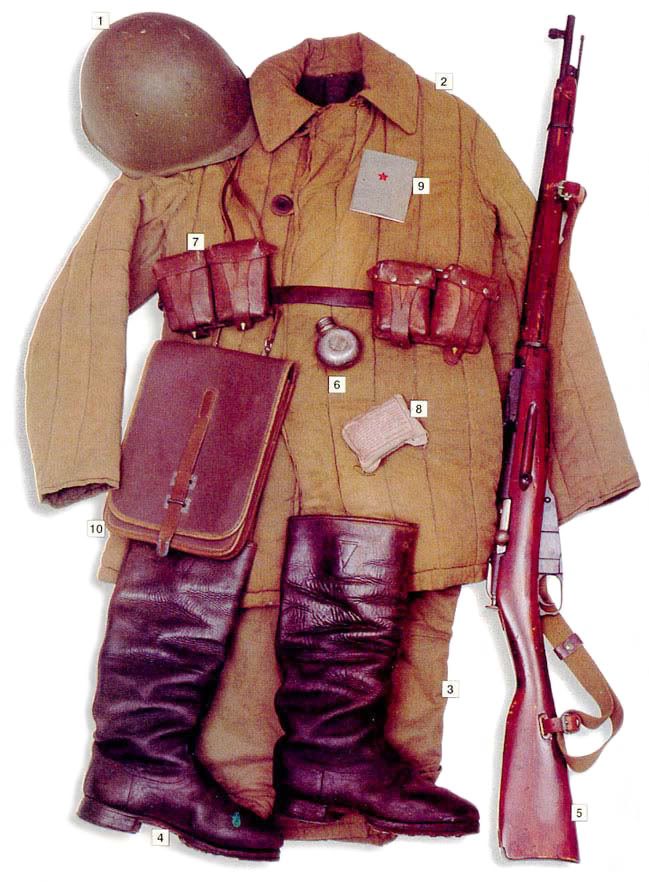
http://i214.photobucket.com/albums/cc212/supta1960/sovietinf1941.jpg

Soviet infantry, 1941
01 - Model 1940 steel helmet
02 - "Telogreika" jacket
03 - field trousers
04 - boots
05 - 7,62 mm Mosin 91/30 rifle
06 - rifle oiler
07 - Model 1930 ammo pouches
08 - personal dressing
09 - military ID
10 - synthetic leather map pouch
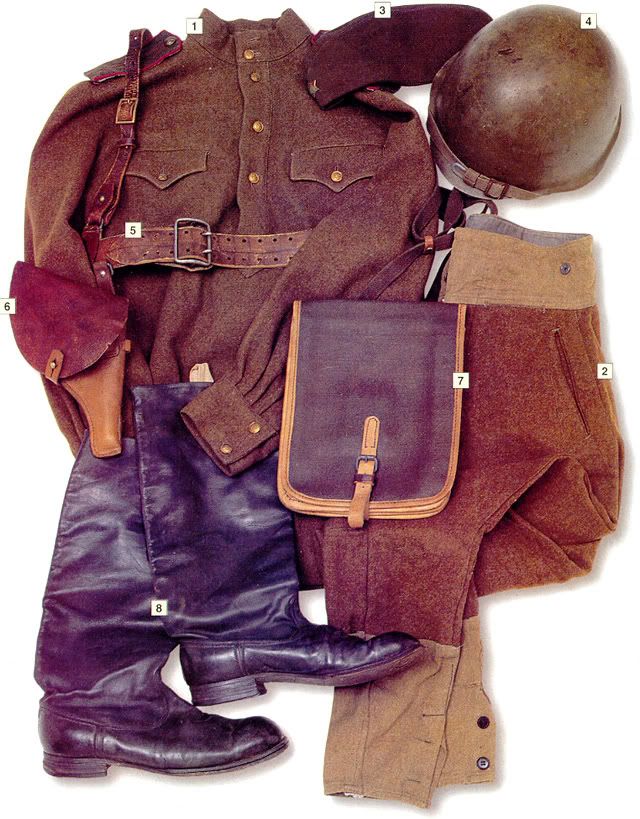
http://i214.photobucket.com/albums/cc212/supta1960/sovietinfoffficer1944.jpg

Soviet infantry officer, 1943
01 - model 1943 "gimnastiorka" sweatshirt, officers' version
02 - model 1935 breeches
03 - model 1935 forage cap
04 - model 1940 helmet
05 - model 1935 officers' belt and webbing
06 - holster for the Nagant 1895 revolver
07 - map pouch
08 - officers' boots
SOVIET VALLEJO PAINT COLOUR GUIDE
WWII Soviet Infantry


Infantry Uniform
Tunic & Breeches V924 Russian Uniform
V912 Tan Yellow
V824
****(best)V880 Khaki Grey
Belt V822 German Black Brown
Sidecap V924 Russian Uniform
V912 Deck Tan
Officer's Visor Cap V924 Russian Uniform
V912 Deck Tan
Band Infantry V817 Scarlet
Cavalry V925 Blue
Artillery V909 Vermillion
Steel Helmet V894 Russian Green
Greatcoat V880 Khaki Grey
V921 English Uniform
Boots V822 German Black Brown
Black
Packs, carriers, bags, capes V924 Russian Uniform
V916 Sand
V821 German Camo Beige
V912 Deck Tan
V847 Dark Sand
Cloth Webbing V881 Yellow Green
V978 Dark Yellow
Scout Camo Suit V967 Olive Green and V950 Black, or V824 Tan and V941 Brown
Winter Uniforms
Padded jackets V912 Deck Tan
V924 Russian Uniform
V888 Olive Grey
Padded Trousers V924 Russian Uniform
Sheepskin garments V916 Sand Yellow
Fake Fur Hat V992 Neutral Gray
V921 English Uniform
Compressed Felt Boots V922 Neutral Gray
Officer Fur Hat *****Brown color
Infantry Piping & Collar Tabs V817 Scarlet
Shoulder boards V871 Leather Brown


Tanker Uniform
Leather Suit Black
Helmet V924 Russian Uniform

Donnerstag, 14. Februar 2013

Flames of War - Miniatures - Parcels with "reinforcements" arrived

My latest shipments arrived from various won auctions at ebay.

So now I am a proud owner of:

2 T-34/85 obr 1943 Soviet Tanks
2 IS-2 obr 1943 Soviet Tanks
1 Platoon German Grenadiers (Winter uniform)
1 Platoon US Engineer Platoon

Several models from Sytex which I will present in a later special, because I am still awed by the high detailed casting. That is awesome work on 15mm metal figures for a great value prize !

WOW !


Sonntag, 10. Februar 2013

Flames of War - Miniatures - What to do with your spare parts again ?

Heia !

Perhaps you recall the Comrade to comrade post on the Stalin Figure Objective Marker quite a while back. I still found more and more of my blister miniatures being around and not based. I still could not make out what to do with them as all bases are currently settled and filled with whatever miniature fixed to it..... and I really hate to build up a bits box.

While surfing the internet I found out about "Bolt Action" skirmish WW2 rules, browsed a few websites and found a couple of adjustments to fit sizing from 28mm to 15mm... and yeahh my spare minis got a new job.... The real investment here for me was the two cent piece which I will use as a base for them .

Rulebook is not that expensive and as Bolt Action is more a skirmish game with small units my investment here will be the rulebook only. Miniatures I already have !

Cheers for all the guys making 15mm WW2 wargaming that fantastic interesting !


Freitag, 25. Januar 2013

Flames of War - Resources - Dont like plastic, but need a cheap metal alternative ?

Hi all,

last days have been awfully busy at my place and now it is finally time to roam a bit more through the webspace to find something useful for my primary hobby....

As I already cross checked on PSC (Plastic Soldier Company) releases in regards to Panther Tanks and Soviet Infantry in Summer Uniform I still felt a bit uncomfortable on what to do now. Reason is that the bases are now awfully to less of weight and that it is over all simple plastic. I personally prefer somewhat metal as a miniature. After surving through the web I stumbled upon this fine webstore with a nice range on miniatures 15mm ww2.... lets wait and see what the order brings in...

http://www.skytrex.com/220/15mm-german-figure-packs/?offset=20

My list includes:

50 Miniatures in a pack :
Germans in Greycoats (YESSSS Finally we are going for winter)

13,50 british pound sterling (as a special they have 20% off for orders  before 27th of january)


Savings = 35 Miniatures (Platoon Size Battlefront Metal approx 17 Euros)

And as a test for my russians I took the smaller (get to know "Squad Packs" which includes 10 Minis):

Anti-Tank Rifles


Soviet Naval Infantry Section (look much better than the ones by BF)


82mm Mortar Teams (x2) (means two complete teams in the pack):

Maxim Gun Teams (x2)


Donnerstag, 17. Januar 2013

Flames of War - Resources - All books published - a List

Rulebook   (3rd Edition)
The Book of Rules of the Game
 (3rd Edition).
   In this book you will find all the rules, missions and special rules of basic armies (British, Americans, Germans and Soviets).


The set Achtung!
  would find the book of rules on small size (twenty-one cm X  14.8 cm)  more practical to transport due to size and weight. The only information it contains is not the Missions and  Special Rules  for the Army.
  Inside the kit you will also find 3 plastic sherman American and German 2 StugIIIG, dice and a 16-page book for a quick introduction to the game.
Το Βιβλίο Forces περιλαμβάνει 13 Intelligence Briefings και οτιδήποτε χρειαστήτε για να φτιάξετε armoured, mechanised και infantry δυνάμεις από τα 4 βασικά έθνη, τις ΗΠΑ, την Μεγάλη Βρετανία, την Γερμανία και την Σοβιετική ένωση.
The Book  Hobby will find information about activities around the game. How to build your army, guides for assembly and painting. You will also find a guide on how to make your terrain.
The Book Das , et a book so small in size ( 21cm x 14.8 cm ) which is easier to transport, due to size and weight. In combination with the small Rulebook will find in the set Open Fire, an ideal combination for our games in tournaments or generally outside of our house.
Περιέχει Rules Mission, Missions, Late-War Airborne Assaults, Amphibious Assaults, Bocage Rules, Rivers Rules, Rules Fortifications, Street Fighting Rules, Total War, Complete Arsenals and Special Rules for Germans, British, U.S., Soviet, Finnish, Hungarians, Italian and Romanian forces.

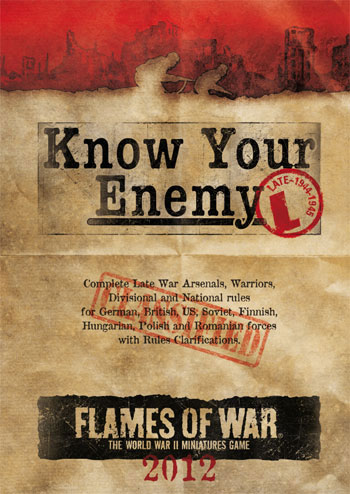
Το Know Your Enemy περιέχει National και Divisional Rules, πληροφορίες για Warriors και πλήρη Arsenals για Αμερικάνους, Γερμανούς, Βρετανούς, Σοβιετικούς, Φιλανδούς, Γάλλους, Πολωνούς και Ρουμάνους
EARLY WAR 1939-41
The first official book for the period of Early war (1939-1941) is the Blitzkrieg , and refers to the Germans invaded France and Poland.

The Hellfire & Back , refers to the fighting in North Africa in 1940-41.

The Burning Empires  out in front of Greece and Syria in 1941 also contains rules and lists for commando operations.
Project: Operation Marita


MID WAR 1942-43


The Eastern Front theater refers to the Eastern Front during the period 1942-43.
The North Africa mentioned in the Mediterranean theater of operations during the period 1942-43.
The Mid War Monsters released by July 2009 and is essentially a book that refers to experimental vehicles that action or not in the course of 1942-43. Present 18 different vehicles that we can integrate our armies as experimental platoons and only for friendly games (The company tells us that these lists can not participate in tournaments and other official events).


LATE WAR 1944-45
The Turning Tide refers to the battles in France from June 1944 until September 1945.Perilamvanei lists of books Allies D Minus 1, D-Day, Bloody Omaha, Villers Bocage, Monty's Meatgrinder and Cobra where he replaces and many new ones.
The Earth and Steel refers to the battles in France from June 1944 to September 1945. Will be released in February 2011 and will include a list of German books from D-Day, Bloody Omaha, Villers Bocage, Monty's Meatgrinder and Cobra where he replaces as many new ones.
  Το Greywolf περιλαμβάνει όλα τα Intelligent briefings των Γερμανών, Ουγγρων και Φιλανδών από το  Stalin's Onslaught, Hammer and Sickle, River of Heroes και το Stalin's Europe. Επίσης έχουν προστεθεί όλα τα Pdf Intelligent briefings που υπήρχαν στην ιστοσελίδα, κάποια καινούργια και μερικά από το Fortress Europe.
  Το Red Bear  περιλαμβάνει όλα τα Intelligent briefings των Σοβιετικών, Πολωνών και Ρουμάνων από το  Stalin's Onslaught, Hammer and Sickle, River of Heroes και το Stalin's Europe. Επίσης έχουν προστεθεί όλα τα Pdf Intelligent briefings που υπήρχαν στην ιστοσελίδα, κάποια καινούργια και μερικά από το Fortress Europe.
The Hell'S Highway refers to the battles around the cities Eindhoven and Numegen during epichirisis Market Garden.
The A Bridge too Far is the second book of the company Market Garden and refers primarily to the Battle of Arnhem.
The book  Cassino  a naferetai in battles around the famous monastery in Italy during the period January to May 1944. The book  Cassino  is the last line on the front of Italy .
The Dogs and Devils refers to battles Anziotis Italy in 1944.
The Blood, Guts, & Glory refers to armatomachies around the Lorraine made ​​between September 1944 and January 1945.
Ô ο Devil's Charge που αναφέρεται στην δράση του Kampfgruppe Peiper και στην μάχη στην Bulge στις Αρδέννες τον Δεκέμβριο του 1944th

.
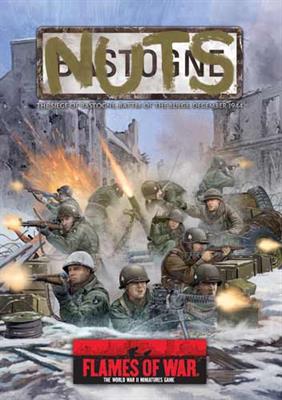
http://www.flamesofwar.com/DesktopModules/Store/Thumbnail.aspx?IP=~/Portals/0/all_images/Books/FW223.jpg&IW=710&IH=400 The Nuts refers to the battles around Bastogne in December 1944.
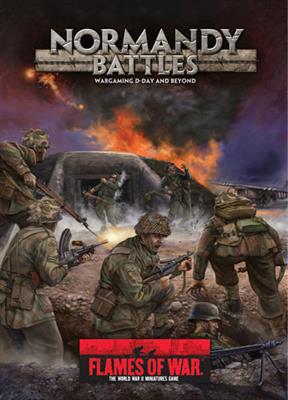
http://www.flamesofwar.com/DesktopModules/Store/Thumbnail.aspx?IP=~/Portals/0/all_images/Books/FW224.jpg&IW=710&IH=400 The Normandy Battles is a book of 112 pages contains scenarios for D-Day.


VIETNAM

Tropic Lightning
Armoured and Airborne Combat in Vietnam (from WI 282)


Old Books !


1st Edition Rules


  In the book outside of the basic rules , there are 4 basic lists for armies of the British, Americans, Germans and Italians, and refers to the period Mid War (1942-43). Alongside website publishing lists for the Early War , the Late war and supplementary lists for Mid war.
  After all the lists are withdrawn and issued the first intelligent book for their armies to specific fronts.


DIVING EAGLES
Intelligence handbook

OLD IRONSIDES
Intelligence handbook on American armored forces.

HITLERS FIRE BRIGADE
Intelligence handbook on German armored forces on the Eastern Front. The Battlefront edition and the second edition of the book.

DESERT RATS
Intelligence handbook for British armored forces in the Mediterranean and North Africa.
DESERT FOX
Intelligence handbook on German armored forces of the Afrika Korp in North Africa.


STALINGRAD
Intelligence handbook on Soviet and German infantry forces. 's book contained rules for street fighting and snipers.

STARS & STRIPES
Intelligence handbook on American armored forces and infantry. In this book you have all the lists from the Old Ironsides which he replaced .

KING & COUNTRY
Intelligence handbook for British infantry forces and the Commonwealth (Australians, New Zealanders, Indians and Canadians).

Avanti SAVOIA
Intelligence handbook on Italian armored forces and infantry.


FOR STALIN!
Intelligence handbook on Soviet forces and armored cavalry.


2nd Edition Rules

  In 2006 the rules were adopted in the second edition, as applicable to today. These intelligent book withdrawn and replaced by North Africa and the Eastern Front , respectively.
AFRIKA
Refers to the Mediterranean theater of operations during the period 1942-43. The Afrika incorporated the older books, Avanti Savoia, King & Country, Stars & Stripes, Desert Fox and Desert Rats . The book was replaced with North Africa in 2009, which includes new listings and new diagrams of the units.
OSTFRONT
Refers to the theater of the Eastern Front during the period 1942-43. The Ostfront incorporated the older books Za Stalina!, Stalingrad, Hitler fire brigade. 's book was replaced with the Eastern Front 20 10 , which includes new listings and diagrams of the new units.
F ESTUNG E UROPA
Refers to the front of northwestern Europe for the period from January to August 1944. This book was replaced by Fortress Europe 20 09 , which includes new listings and new diagrams of the units.
The D Minus the 1st , refers to units of the Allied paratroopers during the invasion of Normandy. 's book was replaced in early 2011 by Turning Tide .
The D-Day , reported the campaign in Normandy from June to August 1944 and mainly contains new rules for landings and battles in bocage. 's book was replaced in early 2011 by Turning Tide and Earth and SteeL .
The Bloody Omaha , refers to the landing at Omaha beach in Normandy. 's book was replaced in early 2011 by Turning Tide and Earth and SteeL .
The Villers Bocage , refers to the battles around the village in 1944. 's book was replaced in early 2011 by Turning Tide and Earth and SteeL .
The Monty's Meatgrinder , refers to the battles around Caen in July and August 1944. 's book was replaced in early 2011 by Turning Tide and Earth and SteeL .
From the book Cobra and after, the company changed the form of diagrams of the units making it more document.
The Cobra , Cobra refers to business conducted in July and August 1944. 's book was replaced in early 2011 by Turning Tide and Earth and Stee L .
The  Fortress Europe  mentioned in front of northwestern Europe for the period from January to August 1944. The Fortress Europe replaced the Festung Europa.  's book was replaced in early 2012 by the Flames of War Forces of the third issue of Anon
The  Stalin's Onslaught , refers to the battles around the Russian city of Orsha (Operation Bagration) in June 1944.  's book was replaced in late 2011 by Grey Wolf and Red Bear.
The  Hammer & Sickle , refers to the second phase of Operation Bagration in 1944. 's book was replaced in late 2011 by Grey Wolf and Red Bear. 
The book  River of Heroes  refers to battles where the Vistula river brought the end of the operation  Bagration. 's book was replaced in late 2011 by Grey Wolf and Red Bear. 
Το Βιβλίο Stalin's Europe - The Soviet Invasion of Eastern Europe αναφέρεται στις μάχες στο ανατολικό μέτωπο από τον Οκτώβριο του 1944 έως τον Φεβρουάριο του 1945. Το βιβλίο αυτό αντικαταστάθηκε στα τέλη του 2011 από τα Grey Wolf και  Red Bear.


The Art of war

  In  The Art of war  is a guide to montelistikos miniatures Flames of war on various topics that will pique the interest for more "montelistiki" work on the models.

No1 November 2007

No2 November 2008